By Chuck Roulet, Estate Planning & Elder Law Attorney | Licensed in Florida & Minnesota | Nearly 30 Years of Experience | About Chuck →
I watched my grandparents lose everything to a nursing home — their homes, their savings, and ultimately their dignity — because at the time, Minnesota was not following federal law. My grandfather, a WWII veteran, wept when he realized that even the small home he had inherited from his brother was gone. Minnesota has since been forced to follow federal law, and Florida has followed it for many years. That is the reason I do this work.
I tell you that because I want you to understand something before we go any further: what happened to my family does not have to happen to yours. There are real, legal options for paying for a nursing home without losing everything you have built. Most families just never find out what those options are until the window to use some of them has already closed.
The Call Most Families Get on a Tuesday
Margaret’s daughter Lisa called our office on a Tuesday. Her mother had just been moved into a memory care facility in the Twin Cities. The facility was a good one. The monthly cost was close to ten thousand dollars. And the social worker had just told her, “Your mom has savings, so she pays privately until those run out.” (Details have been changed to protect privacy.)
Lisa asked the question almost every family asks eventually: how do you pay for a nursing home without losing everything? Here is what surprised her, and what surprises most families. The phrase “spend down to Medicaid” is both true and misleading at the same time. There are actually five different ways families pay for nursing home care, and which ones are still available to your family depends almost entirely on timing. Most families only learn what those options were after the window to use them had already closed.
What Nursing Home Care Actually Costs
Most families are not prepared for this number. Using 2024 cost-of-care data for our two states:
- Minnesota (Minneapolis area): a shared nursing home room runs about $146,000 a year; a private room runs about $153,665 a year.
- Florida (North Port/Southwest Florida): a shared room runs about $128,298 a year; a private room runs about $155,490 a year.
A full year of care in either state can easily run past $150,000. And the average nursing home stay lasts well beyond a year for residents with dementia or complex medical needs. Five hundred thousand dollars in savings sounds like a great deal of money — until you are paying one of these bills every month with nothing coming in to replace it.
So when families ask how to protect assets from nursing home costs, what they are really asking is: what are the legal options, and do any of them still apply to us? The answer is almost always yes — usually more than one.
Option 1: Private Pay
This means paying out of pocket from savings, retirement accounts, or the sale of assets. Most families start here, because it requires no planning and no paperwork. Some families have enough to sustain it for the full length of care. Many do not. Private pay gives you the most choice of facility, but it is also the fastest way to exhaust a lifetime of savings if there is no plan behind it.
Option 2: Long-Term Care Insurance
If you or your spouse purchased a long-term care policy years ago, now is the time to find it and read it closely. These policies vary a great deal in what they cover, what triggers a payout, and whether they apply to home care, assisted living, or nursing home care specifically. If a policy exists, start the claims process early — approval can take time, and you do not want to be waiting on it during a crisis.
Option 3: Veterans Benefits — Aid and Attendance
This one is underused, and it deserves more than a passing mention. Aid and Attendance is a VA pension benefit that provides extra monthly income to wartime veterans and surviving spouses who need help with daily activities. That includes nursing home care, assisted living, and in some cases in-home care.
Here is what surprises most families: you do not have to have been injured in service to qualify. Aid and Attendance is needs-based, not service-connected. The requirements are wartime service and financial need, and surviving spouses of wartime veterans can qualify too — which means this benefit reaches a broader group of families than most people realize.
The catch is timing and coordination. Applications typically take weeks to a few months to process, and the rules around asset transfers for VA purposes interact with Medicaid planning in ways that require careful coordination — getting one wrong can affect the other. Because benefit amounts and eligibility rules are updated periodically, confirm current figures with an elder law attorney before you apply. If a veteran or surviving spouse is part of your family, this conversation needs to happen early. For more, see our related article, Using VA Benefits to Pay for Nursing Home Care.
Option 4: Medicaid
Medicaid — the government program that pays for long-term care once a person meets the income and asset requirements — is how the majority of nursing home residents in Minnesota and Florida ultimately pay for care. But there are rules, there is a look-back period on financial transactions, and some assets are treated very differently than families assume. For a deeper look at specific strategies, see Medicaid Planning Strategies for Nursing Home Care.
Option 5: Legal Spend-Down Planning
This is where most families leave money on the table — not because they did anything wrong, but because they never knew the options existed.
Qualifying for Medicaid nursing home coverage does not mean you lose everything. Some assets are exempt. In many cases, the family home is protected while a spouse or dependent is still living there. Certain personal property does not count against you. And there are legal strategies that can protect additional assets, even with a Medicaid application already in process.
What makes this complicated is the look-back period. Medicaid reviews financial transfers made in the five years before the application date. If assets were given away or transferred to family members inside that window, a penalty period may apply — meaning Medicaid will not pay for a period of time, even though the money is already gone. The exact dollar figures involved are updated periodically by the state, so confirm current numbers with an elder law attorney rather than relying on something you read online.
The spouse still living at home — called the community spouse — is also entitled to keep a protected share of the couple’s joint assets and a minimum monthly income. The protection is real. How much of it you can use depends heavily on how early you start and what planning structure is already in place.
Two specific tools worth knowing by name: a Miller Trust (sometimes called a qualified income trust) can help someone whose income is too high to qualify for Medicaid outright, and a personal services contract can let a family member be legally paid for caregiving — moving money out of a countable estate while compensating the person doing the work. Learn more in The Hidden Secret That Could Save Your Home and Life Savings — About Miller Trusts and How Personal Services Contracts Can Protect Your Home.
The Pattern I See in Practice
Families who come in before a diagnosis and before a crisis have the most options. We can look at trusts, at how assets are titled, and at what the look-back window looks like from a planning standpoint. That is what we call the Save Our Home approach — building the protection while you still have full control.
Families who come in after a crisis still have options. Spend-down strategies, community spouse protections, and exempt asset rules are all still on the table. We can often do more than families expect. But the window is tighter, the choices are fewer, and some of the most powerful tools are already off the table by the time care has started.
Done early enough, this is estate planning. After the crisis starts, it is damage control. Both are worth doing. One is worth doing a great deal more.
Lisa’s family found that three of the five options above were still available to them, and they used two. It was not the outcome anyone wanted, but it was far better than if they had waited another month.
If your family is watching someone move toward needing nursing home care, this is exactly what we look at in a Save Our Home consultation — running the actual numbers for your family, in either Minnesota or Florida. Call our Florida office at (941) 909-4644 or our Minnetonka, Minnesota office at (763) 420-5087 to schedule a consultation. Or you can fill out the contact form on this page and a member of our team will reach out to schedule yours.
Want to Protect the Home Before Care Is Ever Needed?
If your parents or spouse are still healthy today, that is the best possible time to plan — not a reason to wait.
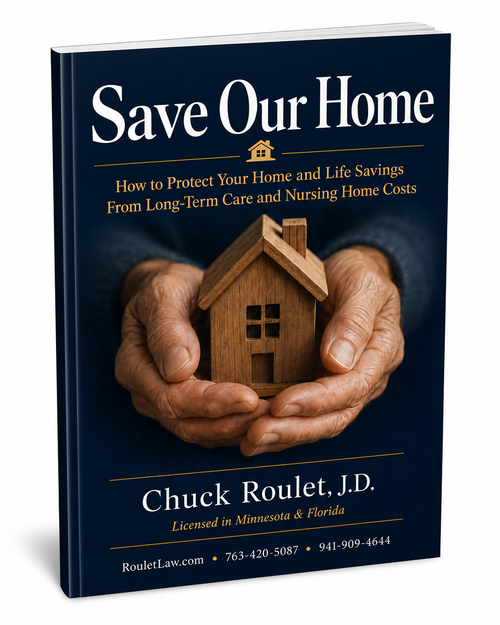
FREE DOWNLOAD: Save Our Home: How to Protect Your Home and Life Savings From Long-Term Care and Nursing Home Costs. A plain-English guide to what actually works in Minnesota and Florida. Download the free guide →
FREE MASTERCLASS: How to Protect Your Home, Savings, and Retirement From Nursing Home and Long-Term Care Costs. A more in-depth walkthrough of these strategies for Minnesota and Florida families. Register for the free masterclass →
And if you are not sure whether your own estate plan is still doing its job — after a marriage, a move, a new grandchild, or simply the passage of time — read our companion article on the 7 life events that mean it’s time to update your will or trust.
Call our Florida office at (941) 909-4644 or our Minnetonka, Minnesota office at (763) 420-5087 to schedule a consultation. Or you can fill out the contact form on this page and a member of our team will reach out to schedule yours.
About Chuck Roulet: Chuck Roulet is the founding attorney of Roulet Law Firm, P.A., with offices in Minnetonka, Minnesota and Venice, Florida. He is one of a small number of attorneys licensed to practice estate planning and elder law in both states simultaneously, with nearly 30 years of experience and 35,000+ attorneys and financial professionals trained through his CLE programs. Learn more about Chuck →