By Chuck Roulet | Estate and Elder Law Attorney | Licensed in Florida and Minnesota
|
Quick Answer If your mother or father was just diagnosed with dementia, you have a narrow — and closing — window to protect their home, savings, and dignity. The most important steps involve getting legal documents signed while your parent still has legal capacity, and beginning Medicaid planning before the 60-month lookback period becomes a problem. Acting within the next 30 days can mean the difference between protecting everything your family worked for and losing it to nursing home costs. |
The phone call no family is ever ready for. The doctor has a diagnosis. Dementia. Alzheimer's. And now, underneath the grief and the fear, a quiet but urgent question begins to form:
What do we do now?
After nearly 30 years of practicing estate and elder law in both Florida and Minnesota, I have sat across the table from hundreds of families in exactly this moment. And what I tell every one of them is the same thing I am going to tell you right now:
You have a window. It may be shorter than you think. And what you do in the next 30 days matters enormously.
This article will walk you through the seven most critical steps to take immediately after a dementia diagnosis — not someday, not when things settle down, but now.
Why the Next 30 Days Are So Critical
Most families make one of two mistakes after a dementia diagnosis. The first is doing nothing — assuming there is time, that the disease will progress slowly, that they will figure it out later. The second is focusing entirely on the medical side and ignoring the legal and financial side until it is too late.
Here is what too late looks like in my practice: a family comes to me after their parent has lost the legal capacity to sign documents. Now, instead of a straightforward planning conversation, we are looking at a guardianship or conservatorship proceeding — an expensive, time-consuming court process that could have been avoided entirely with a simple power of attorney signed six months earlier.
Here is the other version of too late: a family waits to do Medicaid planning until the parent is already in a nursing home. By then, the 60-month lookback period — the five-year window Medicaid uses to review asset transfers — has become the central obstacle to protecting anything.
Acting in the next 30 days keeps both of those doors open.
|
What Is Legal Capacity and Why Does It Matter? Legal capacity is not the same as a medical diagnosis. A person can have a dementia diagnosis and still have the legal capacity to sign documents — meaning they understand what they are signing and its consequences. But that window can close quickly and unpredictably. Once capacity is gone, the only path forward is through the courts. That is why acting now, while the window is open, is so important. |
Step 1: Get a Power of Attorney Signed Immediately
A durable power of attorney is the single most important document your parent can sign right now. It gives a trusted family member or advisor the legal authority to manage financial matters — bank accounts, investments, real estate, bill paying — if your parent becomes unable to do so themselves.
Without it, those accounts can become frozen. Bills go unpaid. Real estate cannot be managed or sold. And the family is forced into a guardianship proceeding that can cost tens of thousands of dollars and take months to resolve.
The key word is durable. A durable power of attorney remains in effect even after the person loses capacity. A regular power of attorney does not. Make sure the document your parent signs is durable.
In Florida, a power of attorney must be signed in front of two witnesses and a notary. In Minnesota, the requirements are similar. This is not a document to download from the internet and fill in yourself — the stakes are too high and the technical requirements too specific.
Step 2: Get a Healthcare Directive and HIPAA Authorization Signed
A healthcare directive — sometimes called a living will or advance directive — tells medical providers what your parent wants if they cannot speak for themselves. It addresses decisions like whether to pursue aggressive treatment, what comfort measures to take, and end of life wishes.
A healthcare surrogate designation (Florida) or healthcare power of attorney (Minnesota) names the person who will make medical decisions when your parent cannot.
And a HIPAA authorization gives family members the legal right to receive medical information. Without it, doctors and hospitals may refuse to discuss your parent's condition with you — even in an emergency.
These documents should be signed at the same time as the financial power of attorney, while capacity exists.
Step 3: Understand the Medicaid Lookback Period — and Why It Starts Now
If your parent may eventually need nursing home care — and with a dementia diagnosis, that is a real possibility — Medicaid planning needs to begin immediately. Here is why:
Medicaid has a 60-month lookback period. When your parent applies for Medicaid long-term care benefits, the state will review every financial transaction made in the previous 60 months. Asset transfers made during that period can result in a penalty — a period of time during which Medicaid will not pay for care, leaving the family to cover costs out of pocket.
The clock on that 60-month window is running right now. Every month you wait to begin planning is one less month of protection you will have when you need it most.
This does not mean you need to transfer everything today. It means you need to sit down with an experienced elder law attorney immediately to understand your options, your timeline, and what moves make sense for your specific situation.
|
Important: The Lookback Period Is Not a Death Sentence Many families assume that because the lookback period exists, planning is useless if a parent is already ill. That is not true. There are legitimate Medicaid planning strategies that work even when a nursing home stay is already underway or imminent. Crisis Medicaid planning is a real discipline, and an experienced elder law attorney can often protect a significant portion of assets even at the last minute. But earlier is always better. |
Step 4: Protect the Family Home
The family home is often the most emotionally significant and financially valuable asset at stake. And it is also one of the most misunderstood.
In most cases, the home is considered an exempt asset while your parent is alive and either living there or in a nursing home with the intent to return. But after your parent passes away, federal law requires states to seek reimbursement for Medicaid costs paid — a process called Medicaid estate recovery. In many cases, that means a claim against the home.
Minnesota has particularly aggressive estate recovery rules. Florida has followed federal law for many years and takes a somewhat different approach. If your parent owns property in both states — or if you are a snowbird family navigating both systems — the differences matter enormously.
The right legal tool to protect the home depends on the state, the specific family situation, and whether planning is happening proactively or in crisis. Options may include a Medicaid Asset Protection Trust, a Lady Bird Deed in Florida, or a different strategy entirely. This is not a one-size-fits-all decision.
Step 5: Review All Existing Estate Planning Documents
Your parent may have a will, a trust, beneficiary designations, or other documents in place — possibly from many years ago. Now is the time to review all of it.
Common problems I see in this review:
• A will-based plan with no trust, meaning everything will go through probate court — public, slow, and expensive.
• Beneficiary designations that are outdated, naming a deceased spouse or an estranged family member.
• A trust that was never properly funded — meaning the assets were never actually transferred into the trust, so it offers no protection.
• Documents drafted in another state that may not be valid or optimal under Florida or Minnesota law.
• No plan at all for a special needs child or grandchild who could lose government benefits if they receive an inheritance incorrectly.
A thorough review now can prevent devastating surprises later.
Step 6: Have the Conversation With the Right Attorney — Not Just Any Attorney
Estate planning and elder law are not the same thing. An attorney who drafts wills and trusts for a living may have little or no experience with Medicaid planning, nursing home contracts, or the specific rules that govern long-term care costs in Florida and Minnesota.
When you are sitting across the table from a nursing home administrator or a Medicaid caseworker, you want an attorney in your corner who has done this hundreds of times — who knows the rules, knows the exceptions, and knows how to protect your family within the law.
If your family has roots in both Minnesota and Florida — which is true for a significant number of the families I work with — you need an attorney licensed in both states who understands both systems. Medicaid is administered at the state level, and the rules are different. What protects a home in Florida may not protect it in Minnesota, and vice versa.
Step 7: Do Not Wait for a Crisis to Call
The single most common thing I hear from families who come to me in a crisis is: I wish we had called sooner.
After a parent has lost capacity. After the nursing home admission papers have been signed. After the assets have already been spent down. After the family home has been lost to Medicaid estate recovery.
I understand why families wait. The diagnosis is overwhelming. There are medical decisions to make, care arrangements to coordinate, family members to notify. Legal and financial planning feels like one more thing on an already impossible list.
But the families who act quickly — who pick up the phone in the first 30 days after a diagnosis — consistently end up in a far better position than those who wait. They have more options, more time, and more ability to protect what their parent worked a lifetime to build.
Why This Is Personal to Me
I did not get into elder law by accident.
My grandparents lost their home, their savings, and their dignity to a nursing home because Minnesota was not following federal law at the time. My grandfather was a World War II veteran. He wept when he learned that everything — including the small home he had inherited from his brother — was gone.
Minnesota has since been forced to follow federal law. Florida has followed federal law for many years. But the threat to families is just as real today as it was for my grandparents. The costs are higher. The rules are more complex. And too many families still do not know that there is a better way.
That is why I do this work. And that is why I want to hear from you before it is too late to help.
Frequently Asked Questions
Can my parent still sign legal documents after a dementia diagnosis?
Possibly, yes. Legal capacity is not automatically lost with a diagnosis. Your parent must understand what they are signing and its consequences. An attorney experienced in elder law can assess capacity and document the signing in a way that protects the validity of the documents. But this window can close quickly — do not wait.
What happens if my parent already lost capacity and has no power of attorney?
You will likely need to pursue a guardianship or conservatorship through the court. This is a formal legal proceeding that takes time and money but does provide the legal authority you need to act on your parent's behalf. Call us as soon as possible — there are steps we can take to move this forward efficiently.
Is it too late to protect assets if my parent is already in a nursing home?
Not necessarily. Crisis Medicaid planning can still protect a significant portion of assets even after a nursing home admission. The strategies available depend on the specific situation — whether there is a spouse still at home, what assets are involved, and what state you are in. Call us to discuss your specific circumstances.
Does my parent need separate estate planning documents for Florida and Minnesota?
If your parent owns property in both states or spends significant time in both states, the answer is almost certainly yes — or at minimum, their existing documents need to be reviewed for compliance with both states' laws. This is one of the most common and costly oversights I see in my practice.
How much does elder law planning cost?
The cost depends on the complexity of the situation and what planning is needed. What I can tell you is that the cost of not planning — lost assets, nursing home spend-down, probate fees, Medicaid penalties — almost always dwarfs the cost of doing it right. Call us for a consultation and we will give you a clear picture of what your situation requires.
Take the First Step Today
If your mother or father has just been diagnosed with dementia — or if you have been putting off this conversation because it felt too overwhelming — now is the time to call.
With nearly 30 years of experience practicing estate and elder law in both Florida and Minnesota, I have helped hundreds of families navigate exactly this moment. I know the rules. I know the strategies. And I know how to protect what your family has worked a lifetime to build.
Call us today to schedule a consultation at either (941) 909-4644 for our Florida office or at (763) 420-5087 for our Minnetonka, Minnesota office. Or you can fill out the contact form on this page and a member of our team will reach out to you. The conversation is confidential. And the sooner we talk, the more options your family will have.
If you would like to discover more, here are some additional resources:
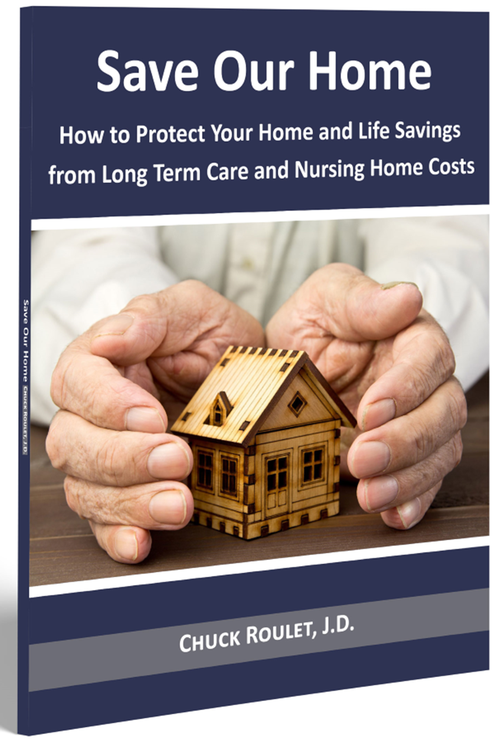
 Download your copy of my guide, Save Our Home. How to Protect Your Home and Life Savings from Long-Term Care and Nursing Home Costs. Click here to get your copy.
 Join us in my upcoming masterclass where I reveal strategies I use with my private clients to help them protect their home and life savings from long-term care and nursing home costs. Click here to sign up.
About the Author
Chuck Roulet is the founding attorney of Roulet Law Firm, P.A., with offices in Minnetonka, Minnesota and Venice, Florida. He is one of a small number of attorneys licensed in both states who practices exclusively in estate planning, elder law, and long-term care planning. With nearly 30 years of experience, Chuck has helped hundreds of families protect their homes, savings, and legacies from the devastating costs of long-term care. He is the author of The Florida Snowbird Guide and has been featured in USA Today and CNN. Roulet Law Firm, P.A.: 763-420-5087 (MN) | 941-909-4644 (FL) | rouletlaw.com
Legal Disclaimer
This article is for general informational purposes only and does not constitute legal advice. Reading this article does not create an attorney-client relationship. Laws vary by state and individual circumstances differ. Please consult a qualified attorney licensed in your state regarding your specific situation.