By Chuck Roulet, Estate Planning & Elder Law Attorney | Licensed in Florida & Minnesota | Nearly 30 Years of Experience | Read full bio →
You got a call you weren't expecting.
It was the title company. They needed your Social Security number for tax reporting. They needed your bank account number to send you a check. And they needed to know when you and your spouse could come in to sign closing documents.
You had no idea your name was on your parents' home.
Or maybe the phone call came from your mother — confused, upset, telling you that the attorney handling her divorce said you needed to come see an estate planning attorney right away. She had no idea the man she'd hoped would be her son-in-law forever had just become a co-owner of her house.
Or maybe you're the parent. Someone told you years ago that putting your kids on the deed would make things easier. Avoid probate. Protect the house. Simple. And now things are anything but simple.
"Why didn't anyone tell me?"
I hear that question in my office more than almost any other. And every time, I have to deliver news that no one wants to hear — news that could have been avoided entirely with the right plan.
In this article, I'm going to explain exactly what happens when parents add children to the title of a home or family cabin, why it almost always creates problems it was meant to solve, and what actually works instead.
I've been practicing estate planning and elder law in Minnesota and Florida for nearly 30 years. These aren't hypotheticals. These are stories from real families who trusted someone's well-meaning advice and paid a price for it.
Why Parents Add Their Kids to the Deed in the First Place
Before I explain the problems, let's be fair. The parents who do this aren't making a reckless decision. They're trying to solve real problems with the tools they think they have. Here are the three reasons I hear most often.
1. To Avoid Probate
Probate is the court-supervised process of transferring a deceased person's assets to their heirs. In Minnesota, it can take a year or more and cost thousands of dollars in attorney fees and court costs. In Florida, it can be equally time-consuming and expensive, and Florida requires probate for real estate even when a will is in place.
When someone tells a parent, "just put your kids on the deed and the house passes automatically when you're gone," they're not entirely wrong. Joint tenancy with right of survivorship does pass outside probate. But the cost of that probate shortcut, as you'll see, is often far higher than probate would have been.
2. To Make It Easier and Simpler to Transfer the Home
The idea is intuitive: if the kids are already on the deed, there's nothing to transfer when the parents are gone. No court. No attorney. Just a death certificate.
Again — not entirely wrong. But "simple" at the end requires everything to go perfectly in the middle. And as you'll see, a lot can go wrong in the middle.
3. To Protect the Home from Nursing Home Costs
This is the big one. And this is where the advice is most dangerously wrong.
Parents are terrified of losing their home to a nursing home. At $146,000 to $153,665 per year for a nursing home room in the Minneapolis area, that fear is completely justified. So when someone suggests that adding the kids to the deed protects the house, it sounds like exactly the solution they need.
It isn't. Not only does it not protect the home — in many cases it makes things significantly worse.
9 Serious Problems That Can Arise When Parents Add Children to the Deed
Problem #1: The Capital Gains Tax Trap — You Gave Away the Wrong Basis
This one surprises almost every family it hits. Here's how it works.
When your parents bought their home decades ago, they paid a certain price — let's say $150,000. That price is called their "cost basis." When you inherit property, you receive what's called a "stepped-up basis." Your basis is reset to the fair market value of the property on the date of the parent's death. If the house was worth $500,000 when your parent died and you sell it for $520,000, you owe capital gains tax on only $20,000.
But when your parent adds you to the deed while they're alive, you receive their original low basis — not a stepped-up basis — for your share of the property. If your basis for your half is $75,000 and the house sells for $500,000, you owe capital gains tax on $175,000 for your half alone. That is not a small number.
A woman came to see me after receiving an unexpected call from a closing company. Her mother was selling the family home to purchase a smaller one, and the title company needed her Social Security number for tax reporting, her bank account for proceeds, and confirmation that she and her husband would attend the closing to sign documents.
She had no idea her name was on the deed. Her parents had added her and one of her brothers to the title years earlier — along with her brother's wife and her own husband, who weren't listed but held legal interests under Minnesota law.
I explained that since the home was not her primary residence, she would owe capital gains tax on her share of the proceeds. She was upset. Then she told me she planned to give the proceeds back to her mother so she could afford the new home.
I had to explain: she could do that. But the money she gave back to her mother would be a taxable gift, requiring her to file a gift tax return. No tax would be due immediately, but it would reduce her lifetime exemption.
She looked at me and said: "But it's mom's money."
I know. That didn't change the law.
Problem #2: The Spousal Interest Problem — One to Buy, Two to Sell
In Minnesota — and in Florida, and in virtually every state — when you add your child to the deed of your home, you are not just adding your child.
A spouse automatically acquires a legal interest in any real property their spouse holds title to. That means the moment you add your daughter to your deed, her husband has rights to that property — even if his name appears nowhere on the document. It takes one person to buy real estate — but two to sell it.
A woman came into my office. Her daughter's divorce attorney had sent her with some paperwork. Her soon-to-be ex-son-in-law was threatening a partition action — a legal proceeding where one or more co-owners ask a court to force the sale of a property so they can receive their share.
She was stunned. "He can't do that. How could he do that?"
After her husband passed, she had added her daughter to the title of her home so it would pass automatically. What nobody told her: the moment her daughter's name went on that deed, her son-in-law's rights attached — automatically, by operation of law. His name was never on the deed. Didn't matter.
The good news: a judge would likely find an equitable solution. The bad news: releasing his interest was going to cost money in the divorce settlement.
She looked at me and said: "Why didn't anyone tell me?"
Problem #3: The Deed Transfer Did NOT Protect the Home from Nursing Home Costs
This is the most dangerous misconception of all. Adding a child to the deed is a transfer of an asset for Medicaid purposes. Under federal law — which both Minnesota and Florida follow — any uncompensated transfer made within five years of a Medicaid application triggers a penalty period during which Medicaid will not pay for nursing home care, even if the applicant is otherwise fully eligible.
So rather than protecting the home, the deed transfer may actually trigger a penalty that leaves your parent without coverage precisely when they need it most.
Even if the five-year look-back period has passed, Medicaid estate recovery rules allow the state to seek reimbursement from the deceased recipient's estate. In Minnesota and Florida, the estate recovery program is active and aggressive. The home may still be at risk.
The tools that actually protect the home from nursing home costs — Medicaid Asset Protection Trusts, properly structured irrevocable trusts — are specific legal instruments designed for that purpose. Adding a name to a deed is not.
Problem #4: When a Child Predeceases — The Probate You Were Trying to Avoid
People add children to the deed specifically to avoid probate. But when a titled co-owner dies before the parent, the deceased child's interest in the property becomes part of their estate — and must go through probate for anyone to have legal authority to convey it.
A couple added their children to the title of their family cabin as tenants in common. One of their children tragically passed away. Years later, they found a buyer, signed a purchase agreement, and set a closing date.
Then the title work came back.
The deceased child's fractional interest was still sitting there, legally unresolved. The closing was stopped. The family spent several months and thousands of dollars opening a probate proceeding for a child who had died years earlier.
The very probate they had tried to avoid became unavoidable — at the worst possible moment, with a ready buyer waiting and a signed contract on the table.
Problem #5: Your Child's Divorce Becomes Your Problem
When your child goes through a divorce, their ownership interest in your home is potentially a marital asset subject to division. Their spouse's attorney will know this. It will create complications — from needing signatures at closing, to potential liens, to leverage used in divorce negotiations.
Problem #6: Your Child's Creditors Can Come After Your Home
When your child is on the deed, their interest in your property is an asset reachable by their creditors. A judgment creditor can place a lien against your child's interest in the property. That lien attaches to the real estate itself. You may not be able to sell or refinance without addressing it.
Problem #7: Bankruptcy Can Force a Mortgage on a Paid-Off Property
When a child with an ownership interest files for bankruptcy, the bankruptcy trustee may seek to liquidate that interest to pay creditors.
A family had added their children to the title of a family cabin that was fully paid off. One child filed for bankruptcy. To preserve the cabin, the family had to obtain a mortgage on a property they owned free and clear — to buy out that child's bankruptcy interest. Every co-owner and their spouse had to sign the mortgage documents. A paid-off cabin suddenly had a debt against it. Everyone was on the hook.
Problem #8: The Financial Aid Consequence You Never Expected
FAFSA — the Free Application for Federal Student Aid — requires families to disclose assets. When parents hold a titled interest in property, that ownership is a reportable asset. A grandchild's financial aid application was denied because the student's parents held a titled interest in the grandparents' home — pushing the family's disclosed assets over the qualifying threshold. Nobody thought about college financial aid when those names went on the deed. But the asset was there. And it counted.
Problem #9: You Can't Just "Take Them Off" the Deed
Removing a person from a deed requires them to voluntarily convey their interest back. If they have an outstanding judgment lien, that lien follows the property even if they sign off. If they're in a divorce, their spouse's interest must be addressed. If they're in bankruptcy, the trustee controls their assets.
The cloud on title is already there. The only question is what it costs to clear it.
One More Problem Nobody Thinks About: The Gift Tax at the Front End
Adding a child to the deed of a home is a taxable gift at the moment of transfer. If the value of their interest exceeds the annual gift tax exclusion, you are required to file a gift tax return. No tax is likely due immediately — but the gift reduces the amount you can transfer tax-free to your heirs when you die. Most families have no idea this is happening at the front end.
The Homestead Benefit Problem: Minnesota and Florida
Both Minnesota and Florida offer significant homestead benefits tied to owner-occupancy. When non-resident co-owners are added to title, homestead status can be jeopardized.
In Florida, the homestead exemption reduces the assessed value of a primary residence for property tax purposes, and the Save Our Homes cap limits annual increases in assessed value. Adding a child who does not live in the home creates complications for these protections.
In Minnesota, the homestead classification affects property tax rates and the homestead market value exclusion. When a co-owner does not use the property as their primary residence, the classification and the tax benefits that come with it may be affected.
What Actually Works: Tools Designed for the Job
For Probate Avoidance and Clean Transfer: A Revocable Living Trust
A properly drafted revocable living trust allows your home — and all your assets — to pass to your heirs without probate, without court involvement, and without any of the risks described above. You retain full control during your lifetime. You can sell, refinance, and change your plans at any time. Your children's spouses have no interest in the trust assets. Creditors cannot reach trust assets. And your children receive a stepped-up basis, which can save them tens or hundreds of thousands of dollars in capital gains taxes.
For Nursing Home and Long-Term Care Protection: A Medicaid Asset Protection Trust
A Medicaid Asset Protection Trust is an irrevocable trust specifically designed to protect your home and assets from nursing home costs and Medicaid estate recovery. Assets placed in a properly structured MAPT at least five years before a Medicaid application are generally protected. This is the tool designed for the job.
With nursing home costs in the Minneapolis area running $146,000 to $153,665 per year and $128,298 to $155,490 per year in Southwest Florida, the stakes are too high to rely on a strategy that doesn't work.
For Florida: The Lady Bird Deed
Florida has a specific tool called a Lady Bird Deed — the Enhanced Life Estate Deed — that is far superior to the informal deed transfer strategy described throughout this article. Unlike adding a child to the deed, a Lady Bird Deed does not create a present ownership interest during your lifetime. Beneficiaries receive a stepped-up basis. And it avoids probate.
But a Lady Bird Deed is not without its own risks — including some that overlap with the problems covered here. And for those reasons, I generally do not recommend them for my clients. Before relying on one, read my full analysis and watch the accompanying video on our site:
What a Lady Bird Deed Does — and What It Doesn't rouletlaw.com/library/what-a-lady-bird-deed-does-and-what-it-doesnt-.cfm
For Cabin and Vacation Property: A Cabin Trust or LLC
Family cabins and vacation properties often benefit from a dedicated structure — a cabin trust or properly drafted LLC — that addresses succession, shared use, and exit planning in a way that protects the family relationship as much as the asset itself.
Why I Practice Elder Law
My grandparents lost their home, their savings, and their dignity to a nursing home because Minnesota was not following federal law at the time. My grandfather — a World War II veteran — wept when he learned that everything was gone, including the small home he had inherited from his brother. Minnesota has since been forced to follow federal law. Florida has followed federal law for many years.
That experience is why I do this work. And it is why I take it personally when families come to me after getting advice that sounded simple but cost them everything.
The Bottom Line
Putting a child's name on the deed of a home or cabin is one of the most common estate planning mistakes I see. It's well-intentioned. It seems simple. And it almost always creates problems that are far more complicated — and far more expensive — than the probate or nursing home cost it was meant to prevent.
In my nearly 30 years of practice in Minnesota and Florida, I have never once sat across from a family and said that adding the kids to the deed was a great idea. I have sat across from many families who wish someone had told them sooner.
Now you know. Let's make sure your plan actually protects what you've worked for.
If you have questions about your specific situation — in Minnesota or Florida — I invite you to schedule a consultation. Call our Minnetonka, MN office at (763) 420-5087 or our Venice, FL office at (941) 909-4644. Or you can fill out the contact form on this page and a member of our team will reach out to you.
Free Resources — Start Here
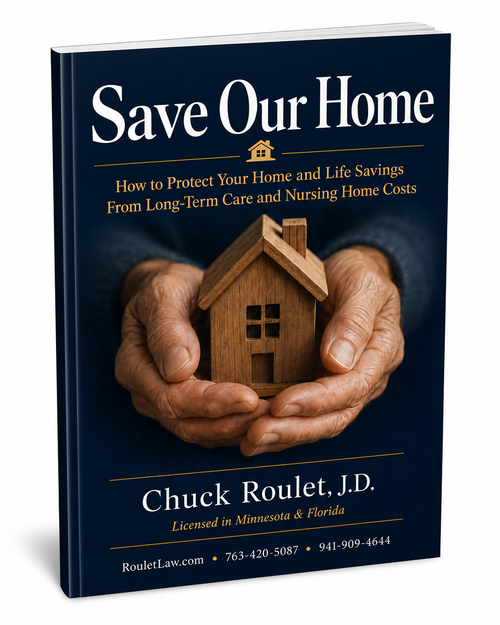
 Download your copy of our guide, Save Our Home: How to Protect Your Home and Life Savings From Long Term Care and Nursing Home Costs. Click here to download your copy.
 Join us in the upcoming masterclass to discover how to avoid probate, save on taxes, protect the money you leave for your kids in the event they get divorced and much more. Click here to sign up.
About the Author
Chuck Roulet is an estate planning and elder law attorney licensed in both Florida and Minnesota, with nearly 30 years of experience counseling families ranging from those protecting a modest home to multi-generational estates in excess of $10 million.
He is the founding attorney of Roulet Law Firm, P.A., with offices in Venice, Florida and Minnetonka, Minnesota — one of a small number of attorneys in the country licensed in both states who practices exclusively in estate planning, elder law, and long-term care planning.
Chuck has trained more than 35,000 attorneys, CPAs, and financial professionals as a nationally recognized continuing legal education speaker — including IRS and U.S. Treasury representatives. He is the author of three books including The Florida Snowbird Guide and the annual consumer guide Save Our Home, and has been featured in USA Today, The Epoch Times, Money Matters, Live Life Large, and other national publications.
Chuck's commitment to elder law is personal. His grandparents lost their home, their savings, and their dignity to a nursing home because Minnesota was not following federal law at the time. His grandfather — a World War II veteran — wept when he learned that everything, including the small home he had inherited from his brother, was gone. That experience drives everything Chuck does for his clients.
Florida Office (Venice): (941) 909-4644 | Minnesota Office (Minnetonka): (763) 420-5087 | rouletlaw.com