By Chuck Roulet, Estate Planning & Elder Law Attorney | Licensed in Minnesota & Florida | Nearly 30 Years of Experience | Read full bio →
If your mom or dad is starting to need more help, one question tends to show up in the middle of the night: if they end up in a nursing home, will I get stuck with the bill?
In Minnesota, the answer is usually no. There is no Minnesota law that makes an adult child pay for a parent’s care. But children in Minnesota still end up paying, not because the law requires it, but because of something they signed or something they did with a parent’s money.
I’ve practiced estate planning and elder law for nearly 30 years, and I’m licensed in Minnesota and Florida. In this article I’ll explain when a child can be made to pay in Minnesota, the three ways families walk into that trap, and what you can do now to protect your parent’s home and savings.
Does Minnesota make adult children pay for a parent’s nursing home care?
No. More than two dozen states have what are called filial responsibility laws. Under those laws, an adult child can be required to pay for a parent’s care. Minnesota is not one of those states. There is no Minnesota law that makes you pay your parent’s nursing home bill just because you are their son or daughter.
Minnesota law goes a step further. Under Minnesota Statutes section 144.6501, a nursing home cannot require anyone to personally guarantee a resident’s bill as a condition of admission, except a financially responsible spouse.
One caution if your parent lives across the border: the rules there are different.
- South Dakota requires an adult child who has the financial ability to provide necessary care, including medical care, for a parent who can’t provide for themselves. The child must receive written notice first, and a child who is sued can seek contribution from brothers and sisters. The South Dakota Supreme Court has upheld a judgment making a son pay his mother’s nursing home bill.
- North Dakota narrowed its law in 2019. Today a nursing home or other creditor generally can recover from an adult child only if the child received the parent’s money or property in a disqualifying transfer, or misused it, within five years, and only up to the value the child received.
If your parent lives in one of those states, talk to an attorney licensed there.
So if the law protects you, how do children in Minnesota still end up paying? There are three ways, and I’ve seen all three.
Trap 1: Signing the wrong paper at admission
This is one of the most common ways I see children end up responsible. They sign the admission agreement without understanding it.
Admission day is usually rushed. A parent is being discharged from the hospital, the family is tired and worried, and someone hands over a stack of papers and says, sign here.
In that stack, you may be asked to sign as the responsible party. In Minnesota, a responsible party agrees to use the resident’s money to pay the resident’s bill, and to help apply for Medical Assistance when the time comes. Medical Assistance is Minnesota’s name for Medicaid.
That is very different from a personal guarantee, which is a promise to pay with your own money. A Minnesota nursing home can’t require you to give one. But if you sign one anyway, you may be held to it.
Before you sign anything at admission:
- Read every page.
- If you hold your parent’s power of attorney, sign as their agent, not as yourself.
- If any page says you personally guarantee payment, stop and ask questions before you sign it.
Trap 2: How you handle your parent’s money after you sign
Signing as the responsible party comes with duties. Under Minnesota law, if you sign as the responsible party and then don’t pay the nursing home out of your parent’s funds, you can become personally liable. The same is true if you knowingly fail to spend your parent’s assets the right way to qualify for Medical Assistance.
In plain English: once you take on that job, your parent’s money has to go to your parent’s care. Not to you, not to your brother or sister, and not to the grandkids.
Trap 3: Moving your parent’s money the wrong way
This is the one I see most often, and it almost always starts with good intentions.
Many years ago I was involved in a case I’ve never forgotten. A woman’s mother needed to go into a nursing home. Her mom had one wish: she wanted some of her money to go to each of her grandchildren.
So the daughter did what her mom asked. She was her mom’s agent under a power of attorney, and that power of attorney allowed gifts. So she transferred money to each of the grandkids.
Here is what she didn’t know. The power of attorney allowed those gifts, but the nursing home admission agreement she had signed did not. And the gifts ran straight into the five-year look-back.
When her mom’s money ran out, the nursing home sued the daughter, and the nursing home won. She had to pay that money back. And even if the nursing home had never sued her, she still would have had a problem the day she applied for Medical Assistance, because of those gifts.
She wasn’t hiding anything. She wasn’t being greedy. She did exactly what her mother wanted. One conversation with an elder law attorney before she made those gifts would have saved her.
How the five-year look-back works
When someone applies for Medical Assistance to pay for nursing home care, the state looks back 60 months. It reviews the financial records for money or property that was given away, or sold for less than it was worth. If it finds gifts in that window, the applicant can be denied help for a period of time, even if the money is already gone.
That is why the timing of any transfer matters so much, and why a gift that seems harmless today can cause real trouble years later.
The same mistake in other forms
A power of attorney that allows gifts does not make gifts safe. I see the same mistake show up in other ways:
- Moving a parent’s assets to yourself. Some children believe that because the power of attorney allows gifts, they can transfer a parent’s money or property to themselves.
- Giving away the house or other assets. Some parents simply give the house, or other assets, to their children.
- Selling the house for $1. Some families think a parent can sell the house to a child for a dollar. Because the price is far below what the house is worth, the state treats it as a gift.
- Adding a child to the title or the accounts. Some parents add a child’s name to the title of the house, or to their bank and investment accounts. That can count as a gift too, and it creates problems of its own. Click here to read my article discussing why that is a mistake.
- Overspending on a prepaid funeral. You can prepay a funeral, but there is a limit. I know a family whose mother was on Medical Assistance. They used her money to pay for her funeral, and they spent too much. They had to reach into their own pockets to pay the state back.
That’s why I tell families: do not move a dollar of your parent’s money until you have talked to an elder law attorney.
What is really at stake
Here is the part most people miss. Even if you never pay a dime of your own money, the bill still gets paid. It gets paid out of everything your parents worked for.
According to the 2024 CareScout Cost of Care Survey, a private nursing home room in the Minneapolis area costs $153,665 a year, and a shared room costs $146,000 a year. That is more than $12,000 a month.
At that rate, a paid-off house and a modest savings account can be gone in just a few years. So the real question isn’t only whether you will have to pay. It’s whether there will be anything left of what Mom and Dad built.
Four things you can do now
- Start early if you can. If your parents are still healthy, there are legal ways to protect their home and savings from nursing home costs. It is usually done with a special kind of trust, and it works best when it’s set up at least five years before care is needed.
- Don’t just take the house. Don’t have your parents give you the house, sell it to you for a dollar, or add your name to the title. A gift starts that same five-year clock. Your parents lose control of their own home, and the house is now exposed to your divorce, your creditors, and extra taxes when it’s sold.
- Don’t assume it’s too late. Even when a parent needs care now, there are often still options, especially when one parent is still living at home. But those options depend on doing things in the right order.
- Get the power of attorney done. Make sure your parent has a good power of attorney while they are still able to sign one. Without it, you may have to go to court just to help them.
And if your parents don’t want to talk about any of this, you’re not alone. Most don’t. Sometimes it helps to start with something you can read on your own first.
Common questions
Can a nursing home sue me for my parent’s bill in Minnesota?
Not just because you are their child. Minnesota has no filial responsibility law. A nursing home can come after a child when the child signed a personal guarantee, signed as the responsible party and didn’t pay the bill from the parent’s funds or didn’t spend down properly, or received the parent’s money or property, as in the case described above.
Does having my parent’s power of attorney make me responsible for the bill?
Not by itself. As agent, you act with your parent’s money, not your own. Problems start when an agent signs something personally, such as a guarantee, or uses the power of attorney to make gifts without understanding the look-back.
How long is the Medical Assistance look-back in Minnesota?
Sixty months, or five years, before the application for Medical Assistance to pay for nursing home care. Gifts and below-value sales in that window can lead to a period when Medical Assistance will not pay.
Can my parent sell me the house for $1 to protect it?
No. Because the price is far below what the house is worth, the state treats the sale as a gift, and it falls under the look-back. It also exposes the house to your own divorce, creditors and taxes.
My parent already gave money or the house to family. What now?
Talk to an elder law attorney before anything else happens. Depending on the timing and the amounts, there may still be options, but the order you do things in matters.
Are the rules the same in Florida?
No. Florida’s rules are different, and I cover Florida separately.
Where to start
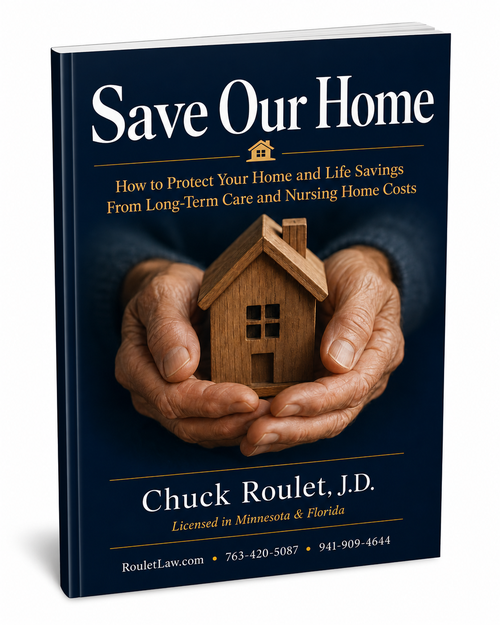
If you’re just starting to think about this, read my guide, How to Protect Your Home from Nursing Home Costs: Click here to download your copy. Read it yourself first, then share it with your parents, or with your brothers and sisters.
If your family is facing this right now, maybe a diagnosis, a fall, or a hospital telling you to find a facility, please don’t guess. Call our Minnetonka office at 763-420-5087 to schedule a consultation, or you can fill out the contact form on this page and a member of our team will reach out to you to schedule your consultation.
About the Author
Chuck Roulet is the founding attorney of Roulet Law Firm, P.A., with nearly 30 years of experience in estate planning, elder law, and long-term care planning. He is licensed in both Florida and Minnesota — one of the few attorneys in the country who advises families navigating the laws of both states. He is the author of The Florida Snowbird Guide and has been featured in USA Today, The Epoch Times, Money Matters, and Live Life Large. Chuck serves clients from offices in Venice, Florida and Minnetonka, Minnesota.
This article is for general informational purposes only and does not constitute legal advice. Reading it does not create an attorney-client relationship. Laws change and every family is different, so please talk with an attorney licensed in your state about your specific situation.